
Fall 2012 Judicial Council
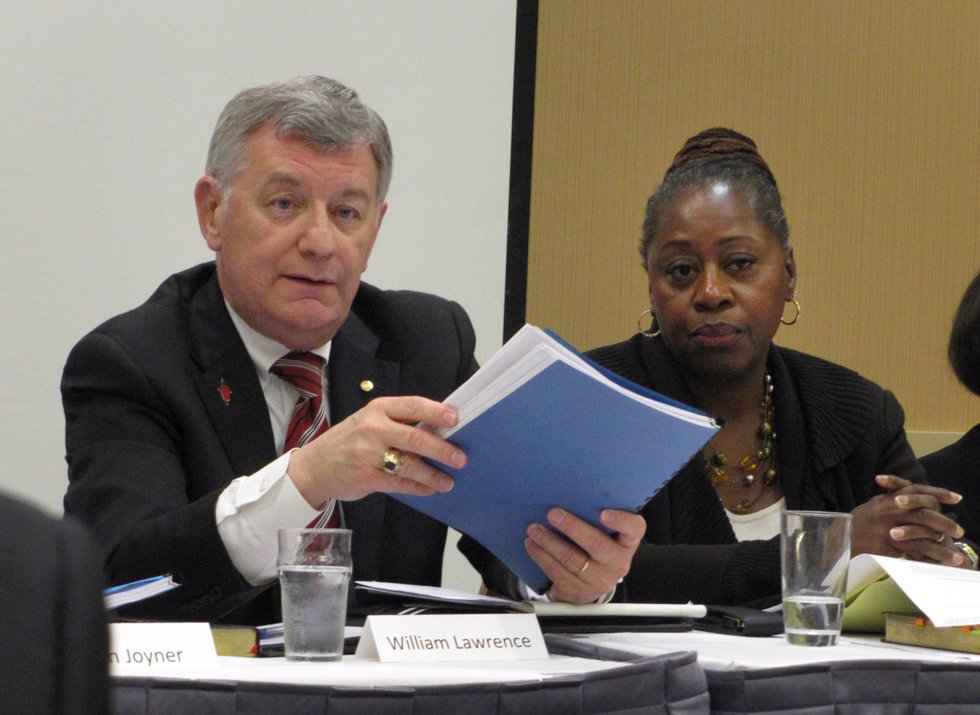
Members of the Judicial Council William Lawrence and Angela Brown review evidence at the October 2012 session.UMNS Photo by Anne Marie Gerhardt.Editorial Analysis
The case of involuntarily retired Bishop W. Earl Bledsoe, who has now been restored to active status by the United Methodist Judicial Council, can be seen as a microcosm of the denomination's current state of dysfunction – particularly because the bishop's appeal was decided not on the merits of his personnel evaluation, but on technicalities of process.
Specifically, the Judicial Council didn't rule on whether Bishop Bledsoe is truly an ineffective general superintendent. Instead, as shrewdly argued by Bledsoe's counsel, attorney and former Judicial Council member Jon Gray of Houston, TX, the Judicial Council opted to decide the case solely on whether the process was carried out appropriately. The United Methodist Church's "supreme court" ruled that Bledsoe did not receive the denomination's equivalent of a speedy trial in which he could face his accusers and the evidence against him, as all United Methodist clergy are entitled to receive.
In citing the lack of "fair process" and "timeliness" in the Bledsoe personnel process, the Judicial Council underscored what many rank-and-file United Methodist clergy have experienced for years: The denomination has no truly fair, objective and transparent process for evaluating the performance of its ordained ministers.
Social media chatter confirmed this hypothesis after the Bledsoe decision was announced. While some clergy defended the concept and the application of "fair process" as outlined in the Book of Discipline, others acerbically and even cynically asserted that once someone files a complaint against an ordained clergyperson, he or she is more likely to get "the bum's rush" out of ministry than a timely, fair and impartial hearing. How ironic that a bishop should at last experience what so many clergy under episcopal appointment have faced!
So where does this leave United Methodists after the second-most painful episode of this year (ranking after the 2012 General Conference, viewed by many as largely a failure)? Consider the following:
The Judicial Council has returned to active duty a bishop whose qualifications are publicly tainted but not resolved. Those in the North Texas Conference who have experienced this episode directly may speculate on the bishop's fitness as a "spiritual and temporal" leader as required by the Discipline, but public hearings at the South Central Jurisdiction Conference provided little concrete evidence of the bishop's performance.
The Jurisdictional Committee on the Episcopacy, using the same process to evaluate the performance of all South Central bishops, felt justified in requesting Bishop Bledsoe's retirement when he scored "significantly lower" than all other bishops, in the Judicial Council's words. Clearly, these are not the performance standards by which Bishop Bledsoe expected to be evaluated, based on his initial defense back in July. Bishop Bledsoe took his marching orders from episcopal interviews in 2008 when candidates were urged to "get the numbers up," presumably by any means necessary. Thus Bledsoe resisted when the rules changed on him mid-term.
However, the Judicial Council did not decide this case on these merits. It chose the path of determining the rightness of process rather than of Bledsoe's evaluation by the Jurisdictional Committee on the Episcopacy. As any competent corporate manager can attest, personnel process does not equate to performance merit. Hence JC Ruling 1230 leaves South Central clergy and laity without a clear determination of whether or not Bishop Bledsoe is actually fit to serve the office he holds.
The Judicial Council retained jurisdiction over the case for the purpose of being sure Bishop Bledsoe's support package and legal costs have been met and that he has been properly assigned to a new area as bishop. However, it has not closed the door on more careful handling of future evaluations. Future cases will have to be specific about what is being challenged so that the respondent bishop has something specific to answer.
Unfortunately, in its effort to be clear how "fair process" is defined in Paragraph 408.3, the Judicial Council may have undercut the very purpose for which this "action" was designed, that of preserving the dignity of the bishop and the Church. The Judicial Council has opened up the specifics of a bishop's failures, so that they must become common knowledge when the results have to be shared in front of the Jurisdictional Conference. In effect, Paragraph 408.3 has become a legal process rather than a pastoral one.
It remains to be seen if Jurisdictional and Central Conference Episcopacy Committees will ever have the courage to use this process in future. United Methodism is now back to having no way to retire less-than-competent or openly arbitrary bishops. Bishops will have to be caught in sexual misconduct for any action to be taken against them; anything less will not suffice. This situation leaves the denomination as a whole twisting in the wind regarding how to evaluate the effectiveness of bishops on a par with the rest of ordained clergy.
The Judicial Council ruling has exposed the fundamental lack of trust and integrity that is eroding the denomination.
Jesus spoke to this critical interpersonal need when he advised his followers to avoid taking oaths, to let their "yes" be yes and their "no" be no. As with the partisan cleavage in U.S. politics that has led to congressional gridlock, The United Methodist Church over the past four decades has built up a fortress of law to which it resorts in take-no-prisoners advocacy, rather than attempt the harder work of restorative justice and reconciliation in its corporate relations. How many formal church trials, hearings, "triads," and Judicial Council decisions could be avoided – along with their cost in human and economic terms – if the denomination practiced the forbearance and forgiveness taught by Jesus?
Such a radical approach starts with the difficult task of being honest and vulnerable at the local congregation level. It requires both laity and clergy to be willing to confront, rather than avoid, the conflicts between them, and to forego petty power struggles in favor of mutual reconciliation. This method becomes particularly difficult when the situation involves bishops, for rare indeed is an elder or deacon under appointment or assignment who can "speak truth to power" about a bishop's performance. And as we have just seen in Decision 1230, the Judicial Council has now undermined, if not eliminated, the power of laity to do so through regional committees on episcopacy.
Finally, the Judicial Council ruling in the Bledsoe appeal has confirmed the need to toss out most of the Book of Discipline and start over.
The Discipline, as the collection of church doctrine and laws by which United Methodists govern ourselves, has become so complex and unwieldy that it defies correction. Both the Bledsoe ruling and other fall-docket Judicial Council decisions, coming scant months after the debacle of the 2012 General Conference, demonstrate how badly the UMC needs radical reform, yet is constrained from reform by its own legal structure. Case in point: The attempt to eliminate security of appointment for ordained elders was foiled as much by the fact that not all salient parts of the Discipline were amended as it was by the constitutional principle of guaranteed appointment.
No amount of piecemeal tinkering with the Discipline at the 2016 General Conference will remedy this critical defect. However, the Council of Bishops could give The United Methodist Church a new start by calling a special session of General Conference in 2014 for the sole purpose of eliminating all Disciplinary provisions except for the Constitution and the Restrictive Rules. Then the General Conference could enact a new global structure that would equalize the standing of all regions of the denomination, ending the American domination of the church. This could include giving each region the authority to create its own set of laws – its own contextual Book of Discipline.
Many leaders across the U. S. church believe this method would have several benefits. It would clarify the church's organization. It would move decision-making closer to the grassroots. And it could give the global church new focus on those matters it holds in common, especially worship and evangelism.
Naturally, some doubt this sweeping do-over. Some of the church's ad hoc policy experts point out that there is no consensus on how to manage legal and personnel responsibilities such as trustee obligations, ordination requirements, categories of ordained ministry and so on. Hence, one might not be able to eliminate the existing tangled web of regulations and maintain legal standing.
Furthermore, the Council of Bishops is not a disinterested party in revising the Discipline. Some observers suspect, given the turmoil of the 2012 session, that if a special General Conference were called the bishops would fill its agenda with their own.
Yet the Bledsoe decision makes it clear that the UMC needs reform as radical as John Wesley's original methods. As the Rev. David Lowes Watson aptly observed about spiritual formation during the recent Wesleyan Leadership Conference, we've been tinkering with the UMC's superstructure when we need to tend to its foundation.
These seemingly wide-ranging conclusions track with the Bledsoe ruling because Judicial Council Decision 1230 has raised the bar on this case to the level of a global polity issue, setting loose ramifications that ripple far beyond the boundaries of the South Central Jurisdiction. The question now is whether United Methodist decision-makers will seize this personnel case as the denomination's own performance evaluation, and take steps necessary to carry out a worldwide ministry in the 21st century.